
Emulsion Polymerization Mixing Guide for High-Solids Latex (Coatings & Adhesives)
Emulsion polymerization is a workhorse process for coatings binders, SBR adhesives, and VAE paper binders. In lab and pilot environments, the goal is to maintain consistent dispersion and temperature control through feeds and conversion so particle size and stability stay on target.
Mixing quality becomes the limiting factor as solids rise and viscosity changes. A properly sized overhead stirrer with stable speed control and compatible impellers helps maintain uniform turnover during feeds, reduces localized concentration gradients that can broaden particle size distributions, and supports more even heat distribution during exothermic stages.
|
Talk to us about equipment selection |
Find a distributor |
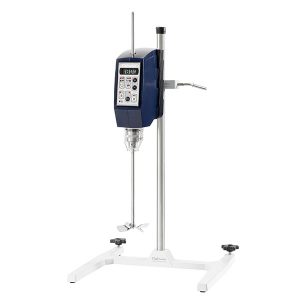
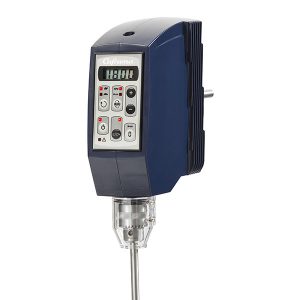
Ultra Torque 1850 system providing torque headroom for higher-solids latex and adhesive applications.
- Coagulum formation increases as solids rise and stability margins tighten.
- Particle size distributions broaden when feeds enter without adequate turnover.
- Thermal hot spots can form if heat is not distributed evenly during conversion.
- Process repeatability suffers when speed control and torque headroom are inconsistent.
What Are the Common Challenges in Latex Production?
Particle size distribution (PSD) broadening during feeds. When monomers, surfactants, or initiators enter a reactor without reliable bulk turnover, localized concentration gradients can promote secondary nucleation or uneven growth. The result is a broader PSD that can drift beyond coating or adhesive specifications, especially in semi-batch processes.
Late-stage instability as solids climb. As conversion progresses, viscosity and collision frequency rise, and the formulation’s stabilization window can narrow. If mixing strategy relies on abrupt speed increases to compensate for viscosity, shear and collision intensity can increase at the wrong time, increasing the likelihood of coagulum and batch failure.
Heat release and temperature non-uniformity. Emulsion polymerization can be strongly exothermic. Even when jacket control is available, temperature uniformity depends on circulation and heat distribution through the bulk. Poor mixing can leave hot regions that affect kinetics, PSD, and in worst cases, safety margins.
- Feed gradients: uneven concentrations can broaden PSD and increase variability.
- Instability at higher solids: poor speed strategy and shear timing can drive coagulum.
- Thermal non-uniformity: uneven heat distribution can shift kinetics and outcomes.
A stable overhead stirring setup helps maintain consistent turnover, speed control, and torque delivery as the batch evolves.
Overhead Stirring Strategies for Emulsion Polymerization
Below are equipment-focused approaches that map common failure points to a mixing action and a starting Caframo configuration. The intent is not to prescribe formulation or kinetics, but to help teams establish repeatable mixing conditions that support PSD control, stability, and heat distribution.
| Challenge | What it causes | What to do | Recommended Caframo setup |
|---|---|---|---|
| PSD broadening from feed gradients | Off-spec tails and batch-to-batch variability during semi-batch feeds. | Maintain steady mid-range RPM during feeds to promote top-to-bottom turnover. Avoid running too slow early, then compensating with abrupt speed jumps later. |
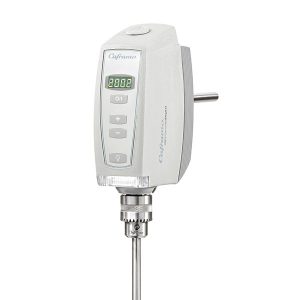
Universal 3030 (BDC3030) + A165 pitched blade Axial-flow pitched blade supports bulk circulation and consistent distribution during feeds. |
| Instability and coagulum risk as solids rise | Coagulum formation, torque spikes, and runs that drift off spec late in conversion. | Use a progressive RPM approach as viscosity changes. Favor torque headroom over excessive speed. If adjustments are needed, step gradually to avoid shear shocks. |
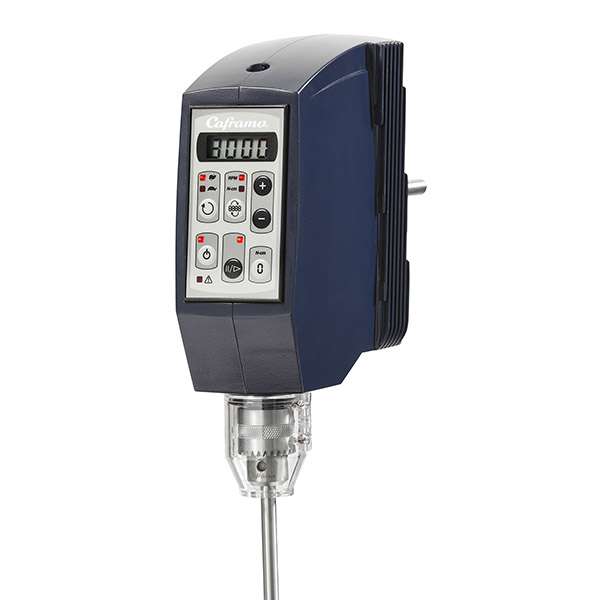
Ultra Torque 1850 (BDC1850) + A165 pitched blade High torque headroom helps maintain circulation without relying on high RPM as viscosity rises. |
| Temperature non-uniformity during exotherm | Hot regions that shift kinetics, contribute to variability, and reduce safety margin. | Combine jacket control with stable circulation. Keep RPM steady enough to distribute heat. Only introduce higher-shear steps if your internal hazard review supports it. |
Universal 3030 (BDC3030) + A165 pitched blade A reliable baseline for circulation in common lab-scale latex reactors. |
- Enough torque headroom to avoid “saving the batch” with high RPM late in conversion.
- Impeller geometry that supports bulk turnover during feeds (often axial flow).
- Stable RPM control for repeatable runs and safer thermal management.
Safety and Materials Compatibility
Emulsion polymerization can involve reactive monomers, initiators, and surfactants, often with exothermic heat release. From an equipment standpoint, the most important step is confirming wetted-material compatibility for shafts and impellers based on your monomers, additives, solvents (if any), and temperature range.
- Confirm impeller and shaft material compatibility (for example, stainless steel vs PTFE) with your chemistry and temperature range.
- Use a secure clamp stand and a stable vessel setup to reduce vibration and improve repeatability.
- Use appropriate guarding and lab controls consistent with your internal process safety requirements.
Want a tighter starting point for stirrer and impeller selection?
Share your reactor volume, target solids range, and viscosity behavior. We can recommend an equipment starting point (stirrer model, impeller type, and a practical RPM strategy) based on mixing requirements.
|
Talk to us about equipment selection |
Find a distributor |
References
-
Lovell, P. A.; Schork, F. J. (2020). Fundamentals of Emulsion Polymerization. Biomacromolecules, 21(11), 4396–4402.
https://doi.org/10.1021/acs.biomac.0c00769 -
Thickett, S. C.; Gilbert, R. G. (2007). Emulsion polymerization: State of the art in kinetics and mechanisms. Polymer, 48(24), 6965–6991.
https://doi.org/10.1016/j.polymer.2007.09.031 -
Guyot, A.; Chu, F.; Schneider, M.; Graillat, C. (2002). High solid content latexes. Progress in Polymer Science, 27(8), 1573–1615.
https://doi.org/10.1016/S0079-6700(02)00014-X -
Jacob, L. I.; Pauer, W. (2022). Scale-up of Emulsion Polymerisation up to 100 L and with a Polymer Content of up to 67 wt%, Monitored by Photon Density Wave Spectroscopy. Polymers, 14(8), 1574.
https://doi.org/10.3390/polym14081574 -
Lovell, P. A.; El-Aasser, M. S. (Eds.). (1997). Emulsion Polymerization and Emulsion Polymers. Wiley. ISBN: 978-0471967460.
Publisher page
