
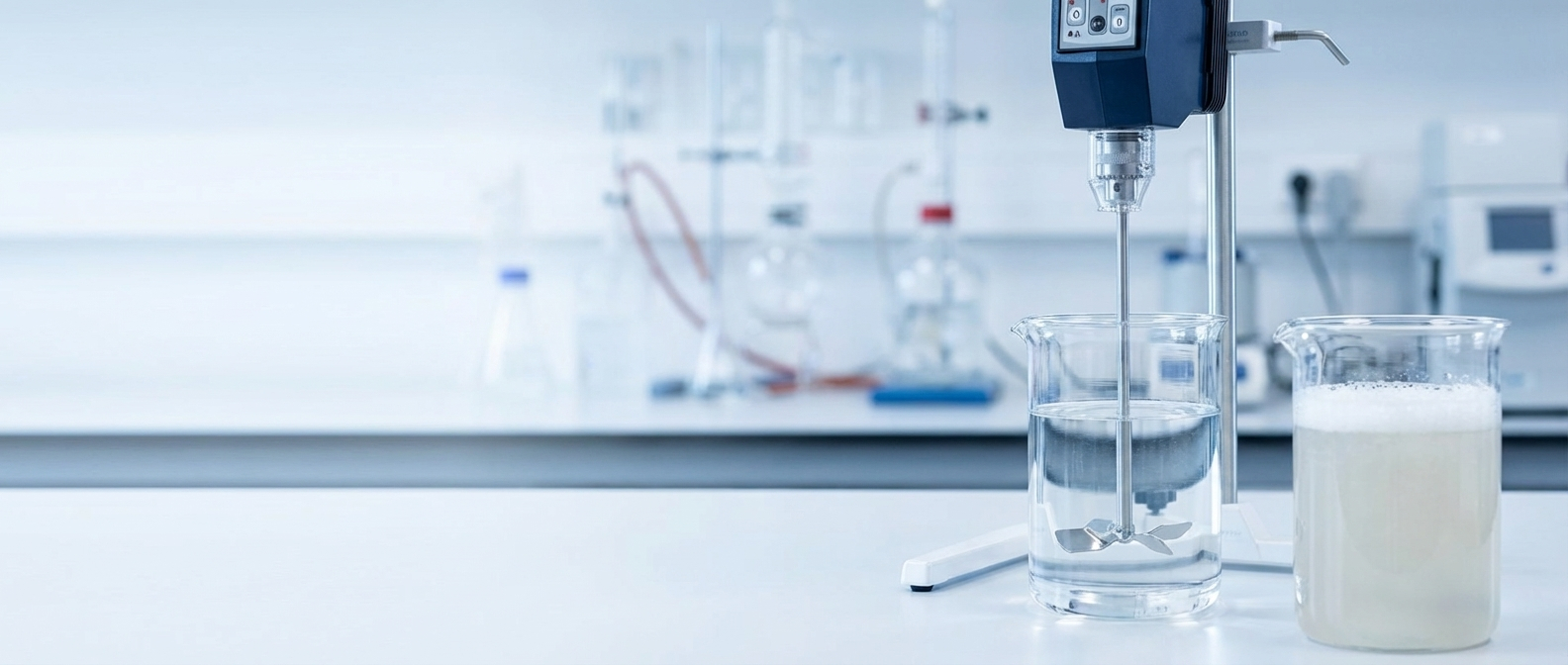
Polymer Solution Preparation for Lab Scale Formulation
Polymer solutions fail in predictable ways: fisheyes (undissolved gel cores), foam and air entrainment, and viscosity drift during hydration or heating. These failures are common in solutions such as HPMC (hydroxypropyl methylcellulose), PVA (polyvinyl alcohol), and membrane “dope” solutions (for example, polysulfone PSf in NMP or DMAc).
- Wet powders cleanly (reduce fisheyes and long clear times).
- Degas without pulling in air (reduce bubbles and optical defects).
- Hold consistency without unnecessary shear (reduce drift and variability).
|
Talk to us about equipment selection |
Find a distributor |
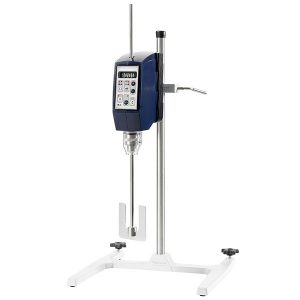
Universal 3030 system is a practical starting point for polymer solution wetting and circulation where viscosity changes over time.
- Pharmaceutical: tablet film coating solutions and controlled-release matrix prep
- Membranes: casting solutions for filtration and separation R&D
- Formulation teams: repeatable viscosity and clarity at lab scale
- Torque limits: viscosity climbs and magnetic coupling can weaken or stall circulation.
- Poor wetting: powders hydrate on the surface and form fisheyes before they can be dispersed.
- Air entrainment: vortexing traps bubbles that resist escape in viscous solutions.
- Geometry constraints: stir bars limit wall sweeping and controlled surface motion.
Why Polymer Solutions Fail (Mixing View)
Fisheyes from incomplete wetting.
Many polymers form gel shells when they contact the solvent surface, trapping dry cores that persist for long periods.
The fix is rarely “more time.” It is usually better wetting and circulation during addition.
Foam and air entrainment.
A deep surface vortex is not a requirement for good mixing and is often the fastest way to pull air into the batch.
Aim for bulk turnover with minimal surface drawdown: keep the impeller fully submerged, avoid aggressive centerline vortexing when possible, and use the lowest RPM that still achieves circulation.
For practical prevention tactics, see
Foaming and Air Entrainment: A Common Mixing Issue
.
Viscosity drift from temperature and shear.
Polymer solutions often thicken as hydration proceeds and can be sensitive to unnecessary shear.
Consistency improves when temperature and RPM are held steady after dissolution, with enough torque to keep the batch uniform without overworking it.
Common Challenges and Equipment Starting Points
| Challenge | What you see | Mixing lever | Caframo starting point |
|---|---|---|---|
| Fisheyes during powder addition | Undissolved gel cores; slow time to clear | Charge powder into moving liquid; axial circulation for wetting; reduce intensity after wet-out |
Universal 3030 (BDC3030) + A165 pitched blade Axial-flow circulation supports wetting and turnover during hydration. |
| Foam and air entrainment | Cloudiness; bubbles that don’t clear; defects in coatings and films | Minimize surface drawdown; keep impeller submerged; adjust RPM to reduce vortexing; wall sweeping can help release trapped air |
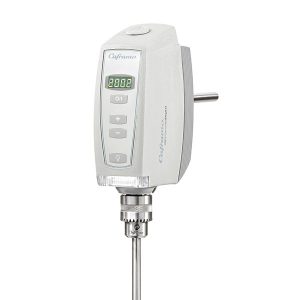
Compact Digital 2002 (BDC2002) + A183 PTFE anchor Tangential-flow wall sweeping supports degassing with low vortex formation. |
| Viscosity drift with time or temperature | Unpredictable cP; poor casting and coating behavior; batch-to-batch variability | Hold temperature and RPM steady post-dissolution; ensure torque headroom for uniformity without unnecessary shear |
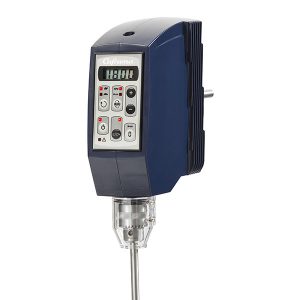
Ultra Torque 1850 (BDC1850) + U044 anchor (or solvent-compatible wall-sweeping geometry) High-torque stability for higher-viscosity dope solutions and consistent circulation during long holds. |
- Wetting is a phase. The “right” intensity during powder addition is often not the right intensity during degassing.
- Anchor-style wall sweeping can reduce vortexing and help bubbles escape in viscous solutions.
- Consistency improves when temperature and RPM are stabilized after dissolution (instead of chasing clarity with more shear).
Safety and Compatibility (Equipment-Focused)
- Solvent compatibility: confirm wetted materials (stainless vs PTFE) against your solvent system and temperature range.
- Mounting and sealing: choose a stand and clamp setup appropriate for your viscosity window; sealed vessels may be required for certain solvent systems.
- Guarding: follow lab practices around rotating shafts and appropriate guarding.
- EHS alignment: follow your SDS and site procedures for solvent handling and ventilation.
References
- Alasfar, R. H., Anis, S. F., Hashaikeh, R., & Hilal, N. (2022). Preparation of PSf Membranes. Polymers, 14(16), 3317. https://doi.org/10.3390/polym14163317
- Joshi, S. C. (2011). Sol-Gel Behavior of HPMC in Ionic Media Including Drug Release. Materials, 4(10), 1861–1905. https://doi.org/10.3390/ma4101861
- Seo, K.-S., Bajracharya, R., Lee, S. H., & Han, H.-K. (2020). Pharmaceutical Application of Tablet Film Coating. Pharmaceutics, 12(9), 853. https://doi.org/10.3390/pharmaceutics12090853
- Takahashi, Y., Ochiai, N., Yanagida, M., Kitade, S., & Noda, I. (1998). Chain degradation in rheological measurements and effects of molecular weight distributions on rheological data for polymer solutions undergoing flow-induced phase separation. Polymer, 39(18), 4313–4317. https://doi.org/10.1016/S0032-3861(97)10118-5
- Caframo Lab Solutions. 7 Factors to Select an Impeller for Dissolving. https://www.caframolabsolutions.com/application/dissolving/7-factors-select-impeller/
- Caframo Lab Solutions. Foaming and Air Entrainment: A Common Mixing Issue. https://www.caframolabsolutions.com/application/emulsifying/foaming-and-air-entrainment-a-common-mixing-issue/
